Why engagement rate matters more than follower count
Follower count is the most visible number on any TikTok profile, but it's also the easiest to inflate and the slowest to reflect current reality. An account can accumulate millions of followers through a single viral video, then produce content for the next year that barely registers. Engagement rate cuts through that noise by measuring what's actually happening: are people responding to the content being posted right now, or is the audience effectively dormant?
For brands evaluating creators for partnerships, engagement rate is often the first filter applied. A creator with 200,000 followers and a 9% engagement rate will typically drive more real-world action than one with 2 million followers and a 0.4% rate. The latter has a bigger number on their profile, but the former has an audience that's actually watching, liking, and reacting. In terms of what a brand actually gets out of a sponsorship, the smaller creator often delivers more.
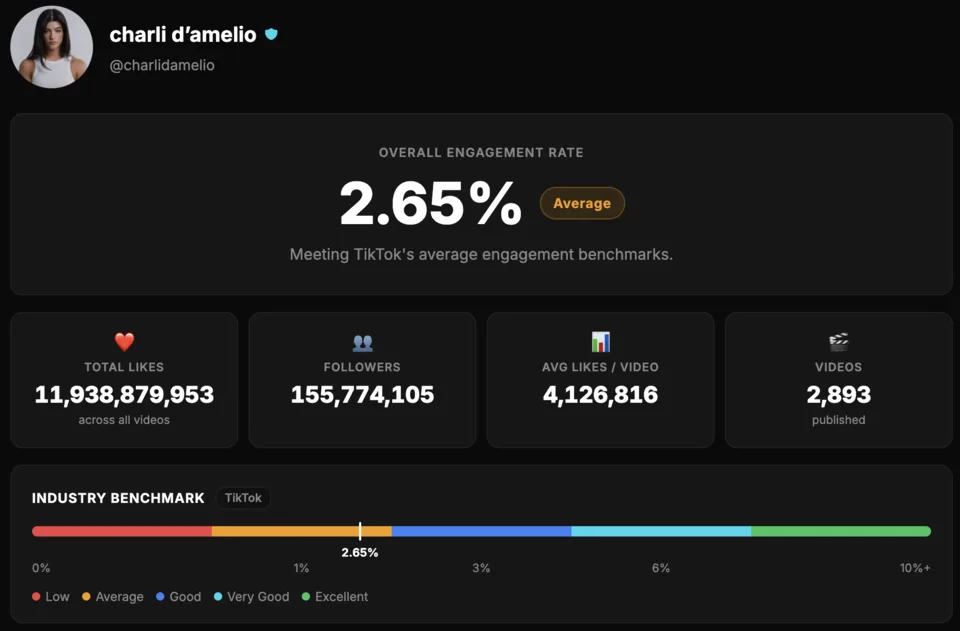
Even for creators assessing their own growth, engagement rate is a more honest signal than raw follower count. A rising engagement rate while posting consistently usually means the algorithm is distributing content more broadly to receptive audiences. A falling rate, even alongside follower growth, can be an early warning sign that the content is drifting away from what the core audience actually wants.
Engagement rate benchmarks on TikTok
TikTok consistently delivers higher engagement rates than other major platforms. Instagram's average hovers around 1–3%, while TikTok accounts regularly see 4–8% or higher. This gap exists partly because TikTok's algorithm actively surfaces content to non-followers who are likely to find it relevant, meaning videos reach primed audiences who are already inclined to engage, not just a static follower base.
One important caveat: very large accounts (10M+ followers) almost always show lower engagement rates simply due to scale. A 1% rate on a 50-million-follower account still means 500,000 likes per video, a number most creators would consider outstanding. Always read engagement rate alongside follower count rather than in isolation.
What affects TikTok engagement?
Account size
Smaller accounts almost always show higher engagement rates. As follower count grows, it becomes mathematically harder to maintain the same percentage of active interaction; the denominator (followers) grows faster than the numerator (likes). This is sometimes called "engagement dilution," and it's why benchmarks should always be interpreted in the context of account size.
Content niche
Tight niche communities (gaming, cooking, a specific sport, a particular genre of music) tend to have more passionate, invested audiences than broad lifestyle or general entertainment accounts. A smaller following in a specific niche often engages at a higher rate than a much larger following built around broadly appealing but less personally resonant content.
Posting frequency
Posting too rarely lets an audience go cold; followers forget the account exists or the algorithm deprioritizes it. Posting too frequently can dilute the average quality per video and spread the same pool of engagement across more posts, pulling the per-video average down. The highest-engagement accounts tend to have a consistent rhythm that keeps the audience primed without overwhelming them.
Audience quality
Accounts that grew organically through genuinely good content typically have more engaged followers than those that relied on follow-for-follow tactics, giveaways, or purchased followers. Organic growth builds a community of people who followed because they wanted to, which is the audience most likely to keep showing up and hitting the like button.